The “Distributed Teams” book – created by a distributed team!

Here’s a little trivia about the book “Distributed Teams: The Art and Practice of Working Together While Physically Apart“. This book *about* distributed teams was created *by* a distributed team.

Catherine, Linda and I live in three different states (California, New York and Utah), in three different timezones and never once met in person during the creation of this book. Instead, we “walked the talk” – following the practices from the book while writing the book.

We held video calls instead of audio-only conference calls. We used pre-agreed Single Source of Truth to track each person’s work as well as the state of the overall project. We had crisply organized communications. Depending on the phase of the project, sometimes we co-worked on multi-hour video calls multiple days in a row and sometimes we didn’t talk all week. But we always knew the latest status of what the others were working on. These, and many other tactics, came from the “How” section of the book and were essential for helping this team work well together while physically apart.

I note for the record: Catherine and I had never worked together before. Linda and I had worked together once before, years ago, on a completely unrelated project. This team went from “forming” to “performing” (bypassing the “storming” part!) while never once meeting in person. It was a great team to be a part of and one of the highlights of the whole book writing process. We’ll be working together again, I know it!

John.

“Distributed Teams” interview on InfoQ.com

Long time readers of InfoQ.com know they cover many different aspects of working in software development: the tools, the technologies, workplace cultural aspects, conferences and yes even books.

All to say, I should not have been too surprised when Ben Linders asked to interview me about my new “Distributed Teams” book. Ben has written several posts about different aspects of distributed teams and remote work over the years, so I was delighted to do this.

We covered lots of details from the book, as well as wider impact of this changing mindset in society. This was a very detailed, thought-provoking, interview and I enjoyed working with Ben on this. The article is now live here on InfoQ.com, so pour yourself a fresh cup of coffee and have a read. Hopefully you’ll like it – and if you *do* like it, please share/tweet about it.

Thank you, Ben, for making this happen.

(oh, and of course, Ben and I did the interview about distributed teams as a distributed team with ~9 hour timezone difference between us!)

“Distributed Teams” now available!

Very late Wednesday night (technically closer to pre-dawn Thursday), I uploaded the final version of the manuscript to Amazon. Then, after I rechecked all my various todo lists one-more-time and found everything was crossed out, I quietly paused with the cursor over the “publish” button.

Took a deep breath.

And clicked “Publish”.

As of last night, you can now buy paperback and kindle versions on Amazon.com. It’s been 3 years and ~2 months since I started this book and I still find it hard to believe that I’m writing this announcement.

This book is aimed towards people working in, joining, or starting a distributed team, with easy-to-read short chapters and practical takeaways on topics like:
* Why distributed teams are good for business, diversity, employee retention, society and the environment.
* How to run efficient video calls and meetings while dealing with lots of email and group chat.
* How to handle complex interpersonal topics such as hiring, firing, one-on-ones, reviews, trust and group culture.

I’m super proud and humbled by the help from many many people who came out of their way to help me make this idea into a reality. If you find this book helpful, please tweet/blog to help spread the word!

John.

“Distributed Teams” book: Now available for pre-order on Amazon.com!


UPDATE: My book is now available on Amazon! More info here or jump straight to buy the book on Amazon by clicking on the thumbnail.

John.


Original post follows.

My book “Distributed Teams” is now available for pre-order on Amazon! Click on the thumbnail to jump straight to the pre-order page!

That was a surreal sentence to write. And daunting to re-read while looking at the remaining ToDo list.

There is a bewildering 1,001 loose details that need to get figured out before the book officially “ships”. Buying ISBN numbers. Debate hardback vs paperback vs ebook. Page margins. Font size. Font. Resolution of images in the book. Book cover design. Create Author page on Amazon. Setup copyright – globally. Decide book pricing. Decide which countries to sell the book in. Fix bugs in the artwork. I’ve been jumping from one topic to another, learning each area as I went along. In this dizzy never-ending ToDo list, “Get book listed on Amazon” was just one more ToDo item. Several attempts failed with different error messages, sending me off debugging yet another problem, until one attempt seemed to complete without any errors?!? Huh – that’s strange. Now what? How do I know if it worked? Was there a dashboard to check status? Oh, wait. Duh. I started up a new browser, went to Amazon.com and searched for “Distributed Teams”, just like a regular user. There it was. Great. That worked. Search by my name. Yep, also there, great. Search by variations of the book title, all good. And then it hit me. Wait. There it was! My book. On Amazon!

There. Is. My. Book. On. Amazon.

Pause. Deep breath. Slowly exhale.

So here we are. At a major milestone.

It feels like I’ve reached the tipping point just like in every software release – while there are always more things being noticed that need to be fixed, the new incoming ToDos with each build are less severe and people start having more discussions about “is this serious enough to hold the release”. Quietly, morale starts improving as people change from wondering “IF it will ship” to wondering “WHEN it will ship”. After all this time headsdown and focused on research, on interviews, on writing and on editing, the nature of working on the book has changed. Instead of spending all my time on the words in the book, I’ve started spending more time on the book. Excitement about finally shipping starts mixing with anxiety about whether others will like it.

Exciting stuff.

John.
ps: For those keeping count, this latest draft is now ER#24. One great friend sent me a gift to help with the book. Nothing says “Hurry up and ship your book already!” like a delivery of ~5lbs of hand roasted, very tasty coffee beans !

Laptop with Coffee

Distributed Teams – Why Now?

Anyone who follows me here will already know I blog, speak, and mentor on the mechanics needed so humans can work well together even when they are physically apart. As I wrap up writing my book, I’ve been focusing on chapters that cover important context around distributed teams, so this post is slightly different to my usual.

Why are so many more people now talking about distributed teams? Over the last year or so, I’ve been giving a series of presentations on the business, social and environmental benefits of distributed teams. One question I hear over and over is “Why now?”. Here are the three biggest reasons I’ve seen so far:

1) Money: Software startups used to raise money for a data-center and a physical office building and staff payrolls. Only then could people start working on The Next Big Thing. Regardless of what your product will be, creating your data-center takes time to setup and has risks – a data-center that is incorrectly sized for future anticipated traffic or with operational problems could kill your company. You could also kill your company by choosing to setup a physical office in the wrong location (limiting hiring) or choosing an office that is too small (disrupting hiring until you relocated or setup a second office location) or too big (needlessly increasing your burn rate even when your cash flow is tight). Since Amazon Web Services became mainstream, it eliminated the lead time for building a data-center. You still pay money for AWS, but it instantly scales up/down as your customer demand grows/shrinks – and some clever engineering can significantly reduce your AWS bills.
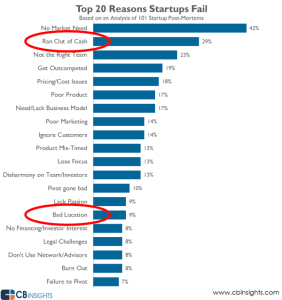
Now that the cost & lead time for a data-center is off the list for most companies, the cost & lead time for a physical office is a expensive outlier that people are starting to question as they look for funding.

2) Social/Economic change: The idea of “a job for life” is no more. People expect to change jobs throughout their career. When people working at high-profile organizations like Google, Facebook, Uber, etc leave after an average of 1.2-1.8 years, that means a person entering the workforce can expect to change companies ~20 times in their ~40 year career. Moving house for your first few jobs might be fun, but after a while most people want to set down roots with a partner, buy a home, grow a community of friends, start raising a family and taking care of parents. Over time, moving becomes harder.

3) Environmental awareness: Requiring everyone to live within commute distance of an office means a lot of commuters. No surprise there. What is less obvious is the ripple effect. As more high-paid people pay more for housing to reduce their commute, it forces displacement of everyone else, so the people who are needed to make a city function are forced to live further and further away. In practical terms that means cops, medics, firefighters, teachers, artists and others all commute longer hours each way to their lower-paid jobs. The term “mega-commuter” is now used to describe anyone who commutes >2.5 hours. Each way. Each day. No wonder traffic in the San Francisco bay area has spiked up 70% since 2010, even though the population “only” increased by 10% in that same time frame. All this traffic has a measurable toll on quality of life, for sure. However, it is also explicitly worth noting that of all the CO2 emissions from the US, the 2nd largest portion of emissions (27%) is from cars, buses and other transportation. Reducing the need for people to commute is an important way for us all to reduce our carbon footprint. Put another way: instead of reducing pollution by promising to buy the latest electric car when it becomes affordable, you could instead start reducing pollution today commuting less often and start working from home. Today.

Each of these are important reasons in their own right. And that’s not even taking into account all the other good business reasons for distributed teams (hiring, retention, diversity, etc). No wonder starting fully distributed companies is becoming mainstream. Hopefully, this book will help them start with the practical mechanics needed to succeed. As more distributed companies succeed, they each help improve the narrative for others who follow.

(This is an extract from my upcoming book “Leading Distributed Teams”. For more on this, see oduinn.com/book.)

John.

“Distributed” ER#15 now available!

I’m excited and a little stunned to say that this update includes the last incomplete chapter! I’ve now written the complete book??!?

To get a free copy of this latest version of the book, just signup on my zero-spam, low-volume mailing list here: oduinn.com/book.

This marks the start of the next phase for this book-writing project – working with editors to cleanup any typos and errors in the text, finding illustrators to replace the screenshots, and going through a long list of “remember to fix…” todo items. The three big items on the list are 1) to start blogging and outreach work to get the word out about this book. 2) update a few remaining chapters to the same consistent structure/format and 3) figure out how to generate PDF and epub versions. Yes this update is still only available in kindle/mobi format, so for now, to read this latest update on your laptop or iphone, you’ll need the Kindle app.

I’ve honestly no idea how much work or time this will take, although I am all-too-aware of the 20/80 rule about “the last 20% takes 80% of the time”. The optimist in me believes that all the great feedback I’ve received so far on all the previous updates will help. A lot. I guess we’ll find out soon enough!

As always, if you have any comments, ideas, concerns, etc., please don’t be shy to contact me. I love the contact and feedback so far, and would like to hear what you think. I again note how great the ongoing moral support and encouragement and excitement from each of you has been through all this. It literally keeps me going. Thank you. Each and every one of you.

John.